Description
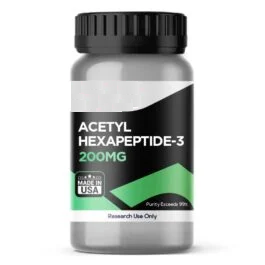
Buy Acetyl Hexapeptide-3 Peptide (Argireline) – Research Peptide
Overview
Buy Acetyl Hexapeptide-3 Peptide a synthetic research peptide widely studied for its role in skin-related and neuromuscular signaling pathways. It is designed to interact with key proteins involved in neurotransmitter release, particularly those linked to muscle contraction and cellular communication.
The peptide is structurally related to components of the SNAP-25 protein, which plays a central role in the SNARE complex. This system is responsible for the controlled release of neurotransmitters such as acetylcholine, which drives muscle activity.
Because of this mechanism, Acetyl Hexapeptide-3 is frequently explored in research focused on facial muscle activity, skin structure, and neuromodulation.
Chemical Profile
- Molecular Formula: C₃₄H₆₀N₁₄O₁₂S
- Molecular Weight: 888.99 g/mol
- Other Names: Argireline, Acetyl Hexapeptide-8
Mechanism of Action (Research Perspective)
Buy Acetyl Hexapeptide-3 Peptide which is believed to influence the SNARE complex by competing with SNAP-25 activity. This may reduce the formation of the protein complex responsible for neurotransmitter release.
In experimental models, this interaction is associated with:
- Reduced acetylcholine release
- Decreased neuromuscular signaling
- Modulation of muscle contraction activity
This makes it a key compound in studies exploring controlled muscle response and skin surface dynamics.
Key Research Applications
Skin & Wrinkle Research
Studies suggest Acetyl Hexapeptide-3 may influence:
- Skin microtexture and surface smoothness
- Appearance of expression-related lines
- Hydration and transepidermal water loss (TEWL)
- Collagen structure balance in skin tissue models
Some research models have reported measurable improvements in wrinkle depth and skin appearance over repeated application periods.
Muscle Activity Studies
Acetyl Hexapeptide-3 is also investigated in neuromuscular research, particularly involving:
- Involuntary muscle contractions
- Facial muscle spasms
- Localized neuromuscular signaling regulation
Its mechanism makes it a useful model compound for studying non-invasive neuromodulation pathways.
Scar Tissue & Skin Remodeling
Research indicates potential involvement in:
- Skin regeneration processes
- Collagen remodeling balance (Type I vs Type III)
- Tissue elasticity in healing models
These properties make it relevant for studies on dermal recovery and structural skin repair.
Neurological & Pain Pathway Research
Modified and palmitoylated versions of this peptide have been studied in relation to:
- Pain signaling modulation
- Inflammatory response pathways
- TRPV1 channel activity
- Mechanical and thermal sensitivity models
These findings place it in broader research exploring neurochemical signaling and sensory response regulation.
Why Researchers Use and Buy Acetyl Hexapeptide-3 Peptide
- Well-studied SNAP-25 analog peptide
- Strong relevance in cosmetic and neuromuscular research
- Multi-pathway interaction (skin, nerve, muscle)
- Useful in both dermatological and neurobiological models
For Research Use Only
Buy Acetyl Hexapeptide-3 Peptide which is intended strictly for laboratory and research applications. It is commonly used in experimental studies related to skin biology, neuromuscular signaling, and peptide-based modulation systems.


Reviews
There are no reviews yet.