Description
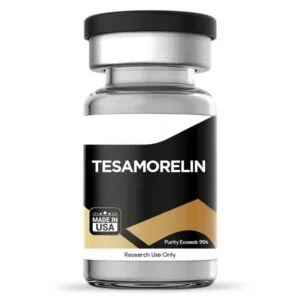
Buy Tesamorelin Peptide – Growth Hormone Research & Visceral Fat Support
Tesamorelin is a synthetic 44-amino-acid peptide analog of growth hormone-releasing hormone (GHRH), designed for research into GH stimulation, IGF-1 signaling, and metabolic function. Modifications at the N-terminus (acetylation) and C-terminus (trans-3-hexenoic acid) enhance stability, potentially protecting the peptide from enzymatic breakdown and improving biological activity.
How Tesamorelin Works
- Growth Hormone Activation: Tesamorelin interacts with GHRH receptors in the anterior pituitary, which may stimulate GH secretion. GH then acts systemically and locally to promote IGF-1 production, supporting anabolic processes across multiple tissues.
- Intracellular Signaling: GH release may involve the cAMP-PKA pathway, activating cellular responses that regulate protein synthesis, metabolism, and tissue repair.
- Fat Reduction: GH has lipolytic effects, targeting abdominal and visceral fat. Tesamorelin may reduce visceral adipose tissue by up to 25% in research models.
- Muscle Support: Studies using CT scans suggest Tesamorelin may improve muscle density and volume, particularly in rectus abdominis, psoas major, and paraspinal muscles.
- Metabolic Impact: Research indicates reductions in triglyceride and cholesterol levels in lipodystrophy models, potentially supporting healthy lipid metabolism.
Research Applications (Tesamorelin for research)
1. Lipodystrophy Studies
Buy Tesamorelin peptide from us which has been examined in models of abnormal fat distribution, showing significant reductions in visceral fat and improvements in metabolic markers, including triglycerides and cholesterol.
2. Hepatic Fat Reduction
In immunodeficient models with high hepatic fat fraction, Tesamorelin reduced liver fat accumulation in 35% of treated subjects, supporting potential research in NAFLD and metabolic liver conditions.
3. Cognitive Research
Ongoing studies are exploring Tesamorelin’s effects on neurocognitive function in immunodeficient subjects, focusing on improvements measured by the Global Deficit Score (GDS).
4. Muscle & Tissue Research
Evidence from CT imaging suggests Tesamorelin may enhance muscle quality, density, and overall volume, providing a tool for studies on muscle physiology and recovery.
5. Metabolic & Insulin Studies
While Tesamorelin did not significantly alter insulin sensitivity in early trials, its role in GH and IGF-1 signaling may provide pathways for exploring metabolic regulation, fat distribution, and energy balance.
Chemical Profile
- Molecular Formula: C₂₂₁H₃₆₆N₇₂O₆₇S
- Molecular Weight: 5136 g/mol
- Other Names: (3E)-hex-3-enoylsomatoliberin, N-(trans-3-hexenoyl)-[Tyr1]hGRF(1–44)NH2 acetate
Reviews
There are no reviews yet.